Mexican crude arbs shift east as Atlantic sour pressure builds
Mexican crude is still anchored in the Atlantic, but the trade is becoming harder to price on historical flows alone. Lower export availability, heavier sour competition in the USGC and Europe, and fresh eastbound flows are making destination economics more important. With Maya now looking more competitive into East Asia, PMI’s next cargo decision is increasingly about where the arb clears strongest, not just where the barrel has traditionally gone.
Key Takeaways
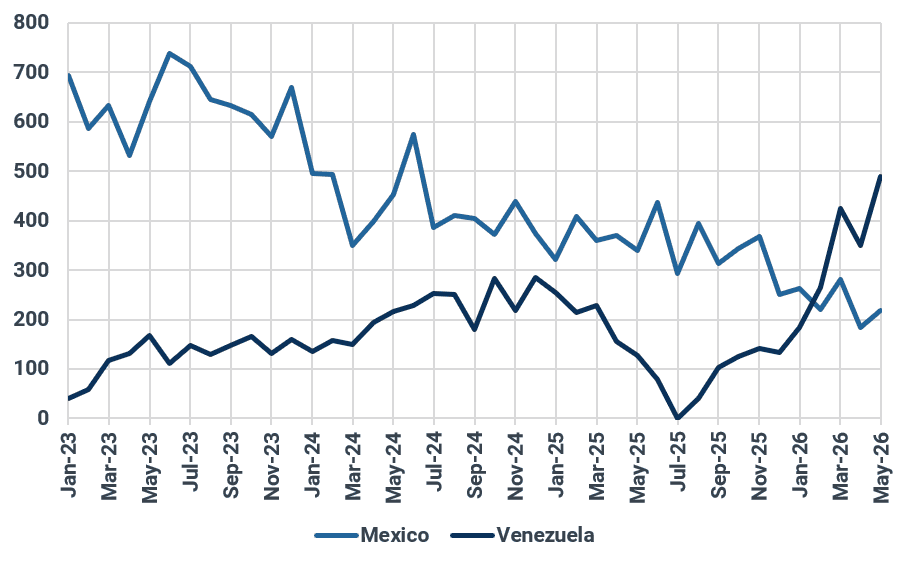
- Atlantic outlets are getting crowded: Mexican arrivals into the USGC have trended lower as domestic refining absorbs more crude, while Venezuelan barrels have rebuilt as a competing heavy sour feedstock.
- The eastbound arb is open: Maya complex margins into East Asia have improved versus Oman as delivered costs decline.
- Scarcity raises the stakes: Lower Mexican export availability means PMI must optimize each cargo for the best netback, not just clear barrels.
While PMI’s crude remains anchored to the USGC, recent dynamics point to a more arbitrage-led strategy. Mexican crude has traditionally cleared into US Gulf Coast refiners, where Maya remains a natural fit for complex sour-processing systems. But the USGC is no longer as straightforward as it once was. Dos Bocas is absorbing more crude into Mexico’s domestic refining system, reducing export availability and contributing to the sharp decline in Mexican arrivals into the Gulf Coast since 2023. At the same time, Venezuelan barrels have rebuilt into a meaningful competing heavy sour feedstock, giving USGC refiners more alternatives when negotiating for Maya.
This creates a two-sided pressure on PMI: fewer Mexican barrels are available for export, but the barrels that do clear into the Atlantic face a more competitive buyer environment. Rising US sour exports into Europe have added another layer of pressure across Atlantic Basin sour grades. PMI’s June K-factor cuts reflect that reality, with values lowered across the USGC, Europe and India, including a $7.30/bbl reduction for Maya into Europe/Middle East and a $4.20/bbl cut into India. Rather than a simple pricing adjustment, the move suggests PMI is positioning its barrels more competitively as refiners gain access to a broader range of sour crude alternatives.
USGC crude imports from Mexico and Venezuela, kbd
Source: Kpler
So where is PMI likely to place its marginal cargoes? In current economics, East Asia looks increasingly attractive. Kpler’s crude arb tool shows July-loading Maya cargoes into complex East Asian refineries have flipped open over the past month, improving by roughly $8/bbl m/m and leaving the grade around $4/bbl more competitive than Oman on a refinery margin basis. The arb is being driven mainly by crude-side weakness. Gasoline has softened, but Maya has cheapened faster than the refined basket, and diesel strength is still supporting complex margins.
Maya is not a direct Oman substitute, but for refiners with coking capacity, comparable middle-distillate yields at a lower delivered crude cost can still improve refinery economics. South Korea is already testing that logic, with two VLCCs carrying Maya and Olmeca heading to Daesan after a six-month hiatus in Mexican crude flows. The initial move may partly reflect supply-security concerns, but current arb signals provide a stronger commercial basis for the flow to repeat.
The Asia-Pacific OSP move reinforces the same logic. By cutting Maya while holding Isthmus and Olmeca steady, PMI is giving the arb support where it is needed without repricing the whole eastern slate. This is not Mexico turning away from the Atlantic; there are not enough export barrels for that. But South Korea now matters more at the margin. When Maya is wide enough versus Oman and diesel cracks hold up, the economics give PMI a reason to keep testing the route rather than treating it as a one-off.
Maya Arbs in the East (Vlcc, complex refinery) -Current vs 4th May snapshot

Source : Kpler

See why the most successful traders and shipping experts use Kpler