


Chokepoint risks could tighten crude supply as Houthis enter the conflict
Two of the world’s most critical maritime routes are being held at risk by Iran and its proxies as the conflict drags into a second month, amplifying pressure on global trade and energy flows. The escalation introduces fresh upside risks to the oil market and is set to deepen the supply squeeze in Asia.
Key takeaways:
- Chokepoint risks tightening prompt supply: March flows through Bab el-Mandeb hit ~4 mbd, the highest since Oct 2023, as Saudi ramps up exports via Yanbu.
- Asia losing prompt barrels: Bypassing Bab el-Mandeb extends Middle East–East Asia voyages to ~50 days, more than double current transit times, and forces tanker repositioning.
- Russian flows sticky but also at risk: ~1.9 mbd of Russian crude continues via the Red Sea, broadly in line with pre-Houthi attacks levels, but security risks are rising.
- Bullish structure building: Red Sea uncertainty supports barrels bypassing both Hormuz and Bab el-Mandeb, firming Dubai pricing into the April cycle.
The Iran-backed Houthis in Yemen marked their entry into the Middle East conflict on Saturday by launching ballistic missiles at Israel. The group has also threatened to close the Bab el-Mandeb Strait to vessels linked to countries it deems hostile to the so-called “axis of resistance.” While their involvement was widely anticipated, the move nonetheless deals a tangible blow to the energy market—particularly as the waterway has become a key route for Middle Eastern crude to bypass the Strait of Hormuz.
Kpler data shows 3.97 mbd of crude has transited the Bab el-Mandeb Strait so far in March—a sharp increase from 2.95 mbd in February and marking the highest level since October 2023, before the Houthis began targeting passing vessels. Of this, 1.75 mbd was loaded from Saudi Arabia’s west coast port of Yanbu, while the bulk of the remainder, 1.79 mbd, was Russian crude bound for Asia.
Crude oil and condensate transit via the Bab el-Mandeb Strait by origin ports, kbd
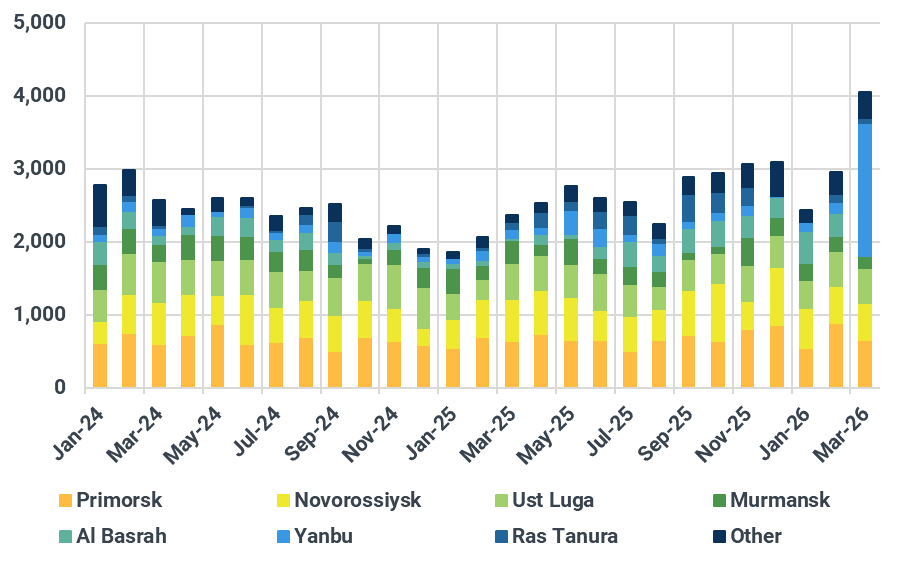
Source: Kpler
Saudi Arabia has ramped up crude exports via its Red Sea infrastructure as the Strait of Hormuz has effectively been closed for a month. At the time of writing, 3.23 mbd of crude has been loaded in March, the highest level on record. Before the war, Yanbu typically shipped around 750–850 kbd of crude. The route is critical for the Kingdom to sustain large-scale production—while most other producers in the region are forced to significantly trim output amid mounting inventory pressure—and for buyers to retain access to roughly a third of non-Iranian Middle Eastern crude.
State oil giant Saudi Aramco has notified its key Asian clients that all April-loading cargoes will be lifted from Yanbu, with Chinese refiners set to receive around 1.33–1.36 mbd and Indian refiners 766–833 kbd. Kpler vessel tracking also shows nearly 30 tankers waiting offshore Yanbu to load, underscoring refiners’ urgency to secure supplies and ease the imminent feedstock crunch.
Notably, crude loadings from Yanbu are so far bound for China (933 kbd), Egypt (720 kbd), India (702 kbd) and Myanmar (143 kbd), with the latter flowing to PetroChina’s Yunnan refinery via pipeline. Despite heightened concerns over supply shortages and an active search for spot cargoes, Japan and South Korea have lifted only 53 kbd and 98 kbd of Saudi crude from Yanbu, respectively. Market participants told Kpler that the two countries appear to have been cautious about routing crude via the Bab el-Mandeb Strait even before the Houthis’ announcement.
If the Houthis were to disrupt traffic through the Bab el-Mandeb Strait, Asian buyers would further lose access to already constrained Middle Eastern crude supplies. Shipowners could reroute westward via the Suez Canal and then around the Cape of Good Hope to deliver Saudi crude to Asia. However, this voyage would take nearly 50 days—more than double the transit time via the Red Sea and effectively reducing prompt availability in the market—and would significantly raise costs due to higher freight rates and increased fuel consumption. It would also require further repositioning of the global tanker fleet, as VLCCs are unable to transit the Suez Canal, reducing overall market efficiency.
It remains unclear how the Houthis will define “hostile” countries and whether Russian oil carriers could also come under threat. Kpler data shows that while overall crude flows through the Bab el-Mandeb Strait declined in 2024 and 2025 following the Houthi attacks, Russian crude shipments have remained broadly stable at around 1.9 mbd, in line with pre-attack levels. As Russian exports are already being undermined by intensifying Ukrainian attacks in recent weeks, any disruption in the Red Sea would further constrain flows to Asia, particularly India.
That said, the Houthis’ entry into the US–Israel conflict with Iran marks a significant escalation and adds upward pressure to oil prices. The threat alone is enough to deter some shipowners from lifting Saudi crude from Yanbu, pushing up prices for Oman and Murban, which are loaded outside the Strait of Hormuz, as well as differentials for African and US crude in the new trading cycle.
Market insights you can actually trust
Kpler delivers unbiased, expert-driven intelligence that helps you to track critical market developments for your own analysis. Our precise forecasting empowers smarter trading and risk management decisions. In times of conflict and geopolitical uncertainty, our real-time data keeps you ahead of supply disruptions and price volatility.
Unbiased. Data-driven. Essential. Request access to Kpler today.

See why the most successful traders and shipping experts use Kpler
![[UPDATE] Middle Eastern supply recovery postponed to early 2027](https://cdn.prod.website-files.com/65059ad784ac02253c62356c/6a69e80d78fefee5dd2f73d6_pipe_line_conection_in_oil_refinery_2_optimized_350.jpeg)






