US waiver on Russian crude offers near-term relief for India’s crude hunt, not a fix
With nearly 50% of India’s crude imports transiting the Strait of Hormuz, the country remains highly exposed to potential supply disruptions. The U.S. waiver allowing additional purchases of Russian crude over baseload offers short-term relief, though competition from Chinese buyers for the same barrels could limit the extent of India’s benefit.
The U.S. Treasury’s decision to grant a temporary 30-day waiver allowing Indian refiners to purchase Russian crude currently stranded at sea is expected to provide near-term relief to India’s crude procurement challenges and help stabilise refinery operations. The timing is particularly important as India imports roughly 50% of its crude through the Strait of Hormuz, leaving the country significantly exposed to ongoing geopolitical tensions and supply disruptions in the region. In a previous report, available in Kpler Insight, we had already highlighted that India was likely to step up purchases of Russian barrels. Against this backdrop, renewed access to Russian barrels could help ease immediate supply pressure and support refinery feedstock availability. The move appears designed to maintain continuity in global oil flows at a time when geopolitical tensions and supply uncertainties in the Middle East remain elevated.
It is also important to note that India had continued importing Russian crude even before the waiver, with baseline flows estimated at around 1000 kbd in recent months. The waiver therefore effectively acts as a green signal for refiners to lift volumes above this base load, enabling them to absorb stranded cargoes and potentially rebuild Russian inflows more quickly than previously expected.
Before December 2025, Russia was a dominant supplier to India's crude demand, accounting for roughly 30-40% of total imports, with flows typically ranging between 1.5–2.0 Mbd. Tariffs and sanctions tightening on Russian crude last year led Indian refiners to recalibrate their crude imports and reduce intake of Russian barrels. With the waiver now in place, refiners could quickly resume purchases, potentially pushing Russian inflows around 1.8 to 2 Mbd in the near term. While this provides a short-term logistical buffer, it cannot fully offset India’s ~2.6 Mbd exposure to Middle Eastern crude, and competition from Chinese buyers for the same Russian barrels will limit the upside
A portion of the recovery could materialise relatively quickly as a significant volume of Russian crude is already positioned across key shipping corridors. As of 6 March, roughly 130 million barrels of Russian crude remain on the water, including around 27 million barrels in the Arabian Sea/Indian Ocean region, about 20 million barrels near the Red Sea and Suez Canal routes, and roughly 7.5 million barrels around Singapore. Many of these cargoes faced delays due to sanctions-related constraints, leaving them effectively stranded across transit routes toward Asia. If commercial agreements are finalised between Indian refiners and Russian sellers or traders, some of these barrels could be redirected toward Indian ports relatively quickly, allowing refiners to secure prompt supply without waiting for new long-haul shipments.
For Indian refiners, renewed access to Russian crude would support feedstock security and margins. However, there has been no official indication of product export curbs from the Indian government. In the near term, refiners are likely to prioritise domestic fuel availability and comfortable stock levels, meaning the increase in crude availability may not immediately translate into higher product exports. Export flows would likely rise only once domestic requirements are satisfied.
From a market perspective, the policy shift could also tighten the availability of Russian export barrels globally. As Indian refiners re-enter the market for these grades, the deep discounts previously associated with Russian crude could narrow significantly, and prompt cargoes may even trade at premiums if competition for available barrels intensifies.
Refiner behaviour will be another key factor to watch. Some refiners in India have largely self-sanctioned Russian crude purchases in recent months due to EU restrictions on imports of products refined from Russian barrels in third countries, which complicates access to European markets. As a result, it remains uncertain whether these refiners will immediately return to Russian supply despite the waiver. In contrast, Indian state-owned OMCs have continued to lift Russian cargoes over the past few months, even as overall flows declined, suggesting they may be more willing to increase purchases under the waiver.
Overall, the waiver provides a temporary but important buffer and helps ease immediate pressure on crude supply chains at a time of elevated geopolitical risk, while potentially reshaping Russian crude pricing dynamics and near-term trade flows. However, as the measure is limited to 30 days, its longer-term impact will depend on whether further policy flexibility emerges and how refiners respond to evolving sanctions and market conditions. If sustained, Russian crude could once again regain a significant share in India’s import basket in the coming months.
India’s crude import (% & Mbd)
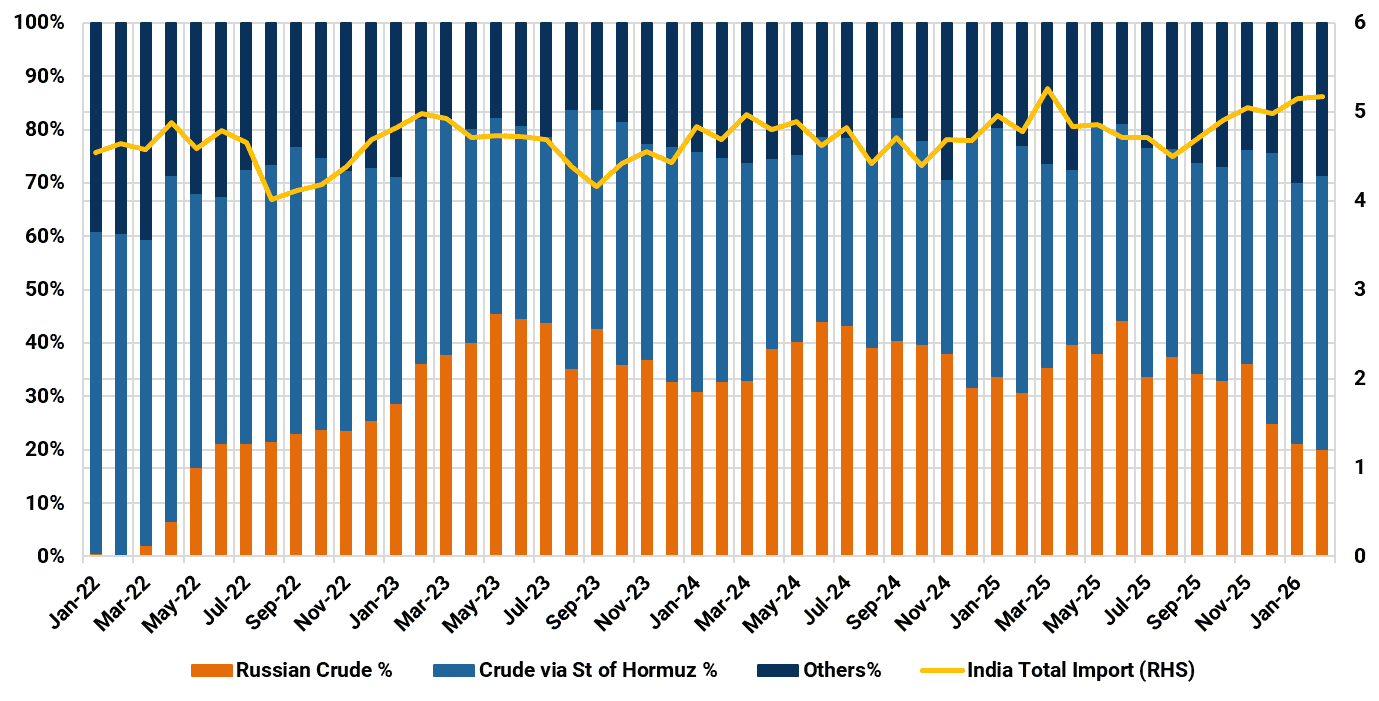
Source: Kpler
Market insights you can actually trust
Kpler delivers unbiased, expert-driven intelligence that helps you to track critical crude oil market developments for your own analysis. Our precise forecasting empowers smarter trading and risk management decisions. In times of conflict and geopolitical uncertainty, our real-time data keeps you ahead of supply disruptions and price volatility.
Unbiased. Data-driven. Essential. Request access to Kpler today.

See why the most successful traders and shipping experts use Kpler

![[UPDATE] Middle Eastern supply recovery postponed to early 2027](https://cdn.prod.website-files.com/65059ad784ac02253c62356c/6a69e80d78fefee5dd2f73d6_pipe_line_conection_in_oil_refinery_2_optimized_350.jpeg)