Know your vessel's actual arrival before your carrier publishes a revision.


.webp)


99%
96%
95%
73%
Challenges
- Cargo on delayed vessels disrupts just-in-time production and triggers demurrage and detention charges, because carrier ETAs lag reality.
- Safety stock and pickup decisions rely on stale milestones, with no independent container visibility into terminal congestion or rollover risk.
Solutions
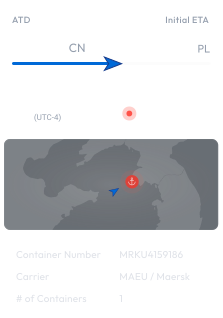
- Container ETA prediction built from live vessel position, port congestion analytics and 13+ years of berth history, updated before the carrier publishes a change.
- Spot rollovers and congestion build-up early enough to rebook, redirect or adjust free-time windows.
.png)
Challenges
- Tracking shipments across carrier portals by hand wastes staff time and slows customer response.
- Customers expect proactive delay alerts, but lagging carrier data puts trust and repeat business at risk.
Solutions
- One container tracking platform consolidates every shipment and milestone, cutting manual work.
- Shareable shipment links let customers self-serve status, reducing update calls and emails.
%20(4)%201%20(1).png)
Challenges
- Carrier portals, emails and EDI feeds force manual reconciliation of conflicting updates.
- Via port and transshipment calls are often missing from carrier updates, leaving blind spots on multi-leg voyages.
Solutions
- One ocean freight tracking platform, via web and DCSA-compliant API, covers every container milestone including all via ports and transshipment calls.
- Operations, planning and customer-facing teams act on the same verified data.
.png)
Challenges
- Building tracking pipelines in-house drains engineering time from core product work.
- Customers expect richer container shipment tracking, but sourcing accurate carrier and AIS data is costly.
Solutions
- Carrier-independent container tracking API, ready to integrate with no in-house build.
- Embed predictive ETAs and port congestion analytics in your own product.
.png)

"We can react much earlier if a shipment arrives late. We also receive detailed insights into the entire transport route of our shipments."

“We had no real-time visibility on our container shipments. Now, we can proactively manage disruptions before they impact production.”
“Shipment insights are accurate and updated in just a few minutes.”

“Initially, our goal was to track around 175,000 containers a year. Since then, customers have grown and we’re tracking upwards of around 1 million containers a year.”

“The accurate, real-time tracking of our shipments ensures that we can provide our customers with precise delivery estimates, which is crucial for their cash flow planning.”
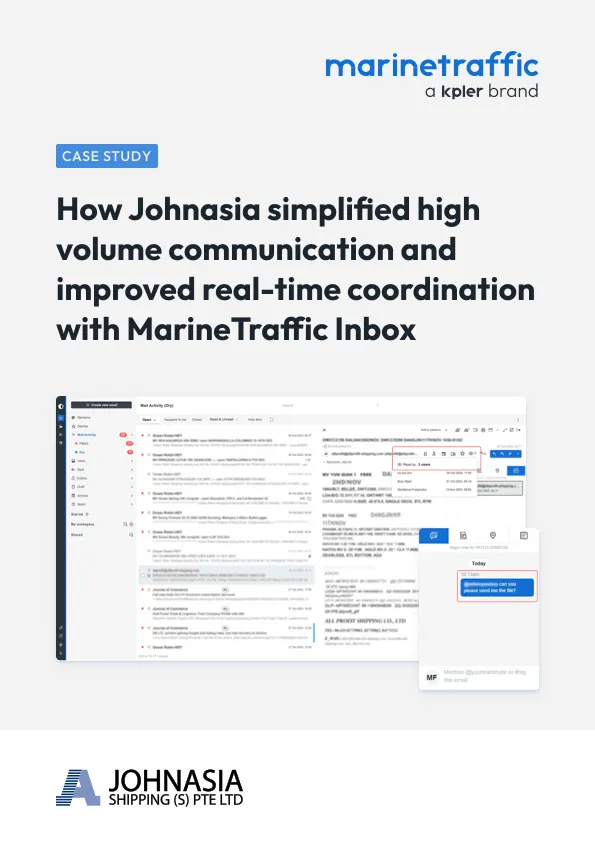
Explore our case studies for maritime markets




FAQ
Container tracking software monitors containers from origin to final discharge, consolidating carrier, vessel and port data into one view. Kpler’s container tracking software goes further than carrier milestones. It uses live AIS vessel data and historical berth behaviour to provide independent container visibility and predictive ETAs, available through a web platform and DCSA-compliant API.
Kpler reconciles multiple carrier schedules against live AIS vessel behaviour and historical berth data. It resolves conflicts such as port skips, added calls and schedule gaps into a single most-likely route. Container ETA prediction updates arrive in minutes, not hours, and match or beat carrier ETAs 95% of the time.
Carrier milestones show only what shipping lines choose to publish, and they lag during congestion, port skips and vessel bunching. Kpler derives every ETA independently from AIS vessel position, port call data and terminal congestion. This gives a carrier-agnostic view of container shipment tracking that lets you anticipate and act ahead of carrier updates.
Every milestone across the voyage: loading, vessel departure, all transshipment via ports, terminal arrival at berth, berth departure at each port call, and final discharge. Carrier updates often omit via port terminal details. Kpler covers every unannounced stop, so container visibility continues even when carrier feeds are silent.
Yes. The API is DCSA-compliant, which makes integration with TMS, ERP and digital control tower systems straightforward regardless of your existing tech stack.
Kpler’s container ETA prediction is derived independently of carrier schedules. It uses live AIS vessel behaviour, terminal congestion and 13+ years of historical berth data. It matches or beats carrier ETAs 95% of the time, and updates arrive in minutes, often before the carrier publishes a revision.
Yes, by flagging rollovers, delays and terminal congestion early, Kpler gives procurement and operations teams time to manage free time, rebook or redirect cargo before D&D charges start. Customers have seen demurrage and detention decrease by up to 73%.