
India stands alone as Asia's demand growth engine as US-Iran hostilities reignite
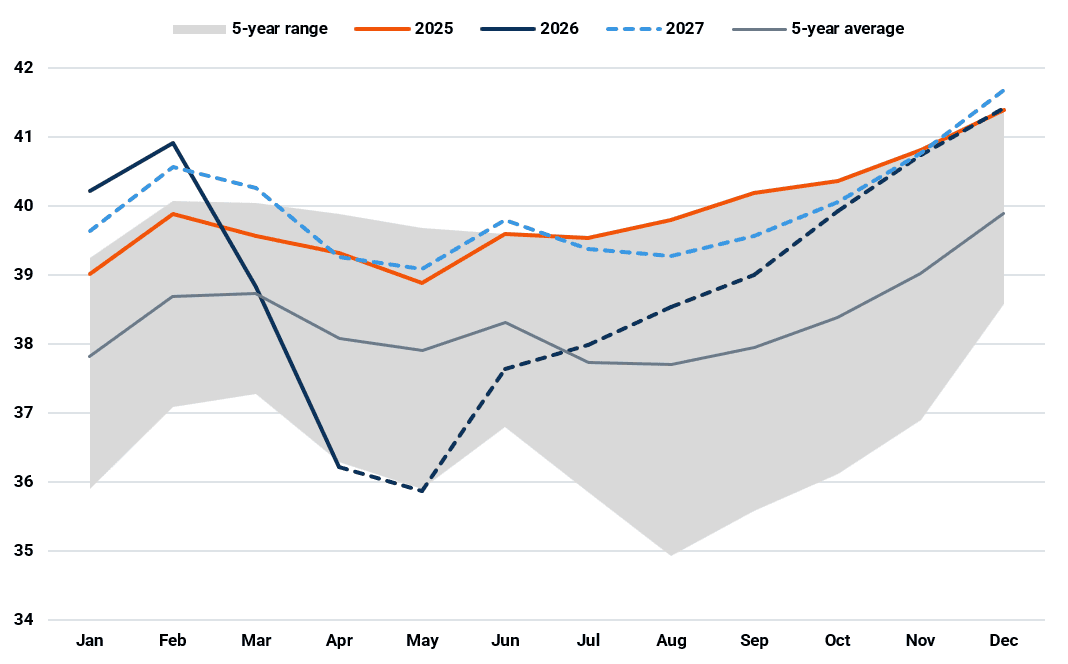
Asia-Pacific refined products demand should hold above May's trough and return to y/y growth by year-end, contingent on the course of the US-Iran conflict and Chinese crude buying. Neither outcome is possible without India.
Asia-Pacific total refined products demand (mbd)
Source: Kpler
Asia-Pacific refined products demand y/y changes by quarter (mbd)

Source: Kpler
Historical data and our implied demand model show Asian products demand falling by 3.11 Mbd y/y in April to its lowest level since October 2021. As detailed in previous analysis, most of these losses stem from the broader consequences of the US-Iran conflict, felt acutely in Asia. Fuel and feedstock shortages, mostly LPG and naphtha into the petrochemical sector and, to a lesser extent, crude into refineries, have either constrained consumption outright or prompted demand-side measures.
Beyond physical supply disruptions, curtailed mobility and activity, higher prices and weakening consumer confidence have dented transport fuel demand across the region. China captures both channels: on top of reduced petrochemical feedstock demand, retail price hikes appear to have intensified the shift away from oil-based transportation through accelerated fleet turnover, in-fleet NEV/PHEV switching and price-induced modal shift toward rail and metro. Layered onto existing structural EV/LNG displacement and the construction/fiscal diesel drag, this drove Chinese transport fuel demand down 580 kbd y/y, or 6.5%, over April-May.
Preliminary June data point to a meaningful recovery across the region. The interim US-Iran ceasefire and the accompanying rebound in export flows through the Strait of Hormuz propped up refinery runs, lowered prices and cushioned end-user demand. We expect demand to continue recovering through H2 and return to expansion by year-end. The renewed escalation of hostilities, however, puts this trajectory at risk: our latest published forecasts rest on a constructive scenario for Strait of Hormuz oil transits, assuming a phased reopening from mid-to-late July and normalization by October, a timeline that recent developments now challenge.
One driver, however, has contributed as much to restored fuel supply, and the ensuing demand recovery, as the ceasefire itself: China. Subdued Chinese crude imports have freed up cargoes for other buyers, allowing refiners elsewhere to lift runs and avert a deeper shortfall. The recovery in Asia-Pacific demand, and the avoidance of a fall below May's trough, therefore, hinges not only on developments in the US-Iran conflict but also on the pace at which Chinese crude buying normalizes.
China seaborne crude imports by origin (mbd)

Source: Kpler
Even under this scenario, we project 2027 demand to average just 80 kbd above 2025 levels, far below the 630 kbd in our pre-conflict forecasts. Half of that downgrade reflects a weaker LPG outlook, particularly for China, where overcapacity persists and the olefins glut will soon remerge, pushing cracker and PDH run rates below the pre-conflict baseline. The conflict has also ratcheted forward China's pre-existing fleet transition away from oil, an acceleration unlikely to reverse as prices normalize and one reinforced by energy-security policy, lowering our medium-term transport fuel outlook.
The rest of non-OECD Asia-Pacific faces a comparable downgrade, on persistent affordability pressure from weakened currencies and fiscal retrenchment, compounded by subsidy reform risk and a cut to our macro assumptions. Rationing-hit South Asian markets carry structural scarring into 2027, while accelerating two/three-wheeler electrification begins to erode the region's gasoline growth trend.
The downtrend applies to every country but one: India. Indian refined products demand has held firm, with the exception of LPG, weighed down in the short term by high dependence on the Strait of Hormuz and structurally by a rewired subsidy architecture heading into 2027: a tighter Ujjwala quota, a retail price ratchet unlikely to fully reverse, and a costlier, longer-freight import slate post-diversification. Transport fuel demand has stayed strong, largely by design, as incomplete price pass-through shields consumers from most of the cost shock. Preliminary industry data for July underscore the momentum, with state refiners' diesel and gasoline sales up over 20% y/y in the first half of the month even as LPG kept contracting. We expect growth to moderate through H2 as price hikes, conservation measures and imported inflation bite, before converging toward the pre-conflict trend in 2027. Even so, India remains the main engine of Asian demand growth, and arguably the decisive one globally.
India refined products demand y/y changes by quarter (kbd)
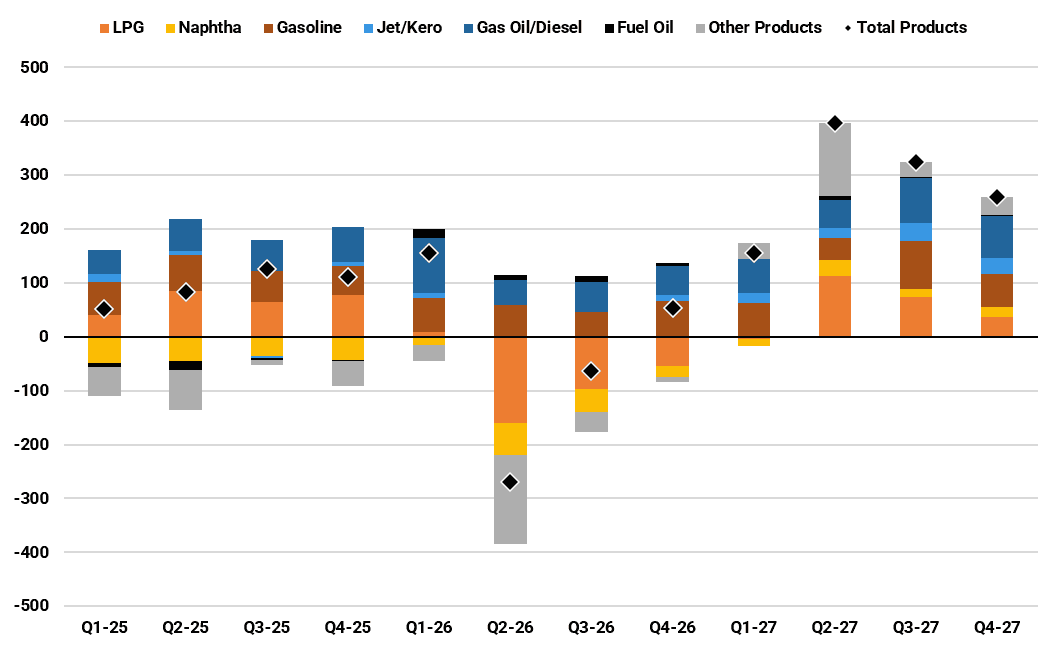
Source: PPAC. All data from July 2026 onwards are Kpler estimates.
Market insights you can trust
Kpler delivers unbiased, expert-driven intelligence that helps you stay ahead of supply, demand, and market shifts.
Trade smarter. Request access to Kpler today.

See why the most successful traders and shipping experts use Kpler