Ukraine’s evolving drone campaign against Russian refining infrastructure
Over the past few months, Ukraine’s drone strikes have entered a far more deliberate and coordinated phase. Instead of isolated, high-profile incidents, we are now seeing a strategy aimed at keeping Russia’s refining system under constant pressure by repeatedly targeting strategically important refineries and critical processing units.
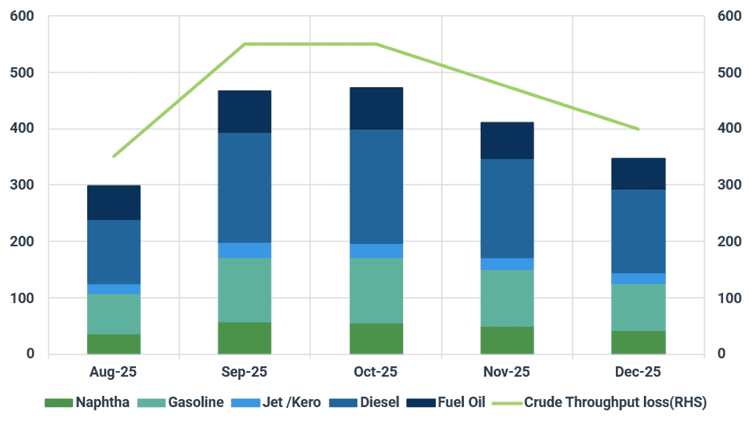
Russian refining operations remain under heavy pressure as ongoing Ukrainian drone strikes disrupt key downstream assets, delay restarts and trigger unplanned shut-ins. Refining throughput slipped to ~5 Mbd in September–November (a 335 kbd y/y drop), with gasoline hit hardest and domestic availability tightening, while gasoil output also declined, reflected in a sharp fall in exports. Unaffected refineries have adjusted maintenance and raised utilisation levels where possible, offsetting some but not all lost volumes. Gasoline supply dropped by ~120kbd over the period, prompting authorities to extend the export ban, waive import tariffs, increase blending, and draw more supply from Belarus. Belarusian gasoline and gasoil inflows have eased pressure, but distribution constraints keep markets tight. Gasoil supply is down ~150 kbd. Looking ahead, crude intake may edge up to ~5.1-5.2 Mbd in December as maintenance winds down, with gasoline stabilising near 900 Kbd and gasoil near 1.9 Mbd; however, runs remain ~400 kbd below expectations due to persistent strikes and spare-part shortages.
Against this backdrop, a clear and evolving pattern in Ukraine’s drone strategy is emerging.
1. From One-Off Damage to Ongoing Disruption
The way Ukraine targets refineries has fundamentally changed. What used to be occasional strikes meant to cause damage has become a sustained effort to keep refineries from ever fully stabilising. Recent attacks show a clear pattern: a refinery is hit, repair teams move in, and then, before the site can recover, another strike follows. Repeated strikes on sites like Ryazan, Novokuibyshevsk, Volgograd and Saratov have kept significant capacity offline. This often happens over a two-to-three-week cycle, turning ordinary maintenance periods into high-risk moments and slowing the pace of every repair. By forcing repeated shutdowns, interrupting repair works, and targeting facilities during restarts, Ukraine ensures that refineries face elevated operational risks and slower return-to-service timelines. The goal is not simply to damage assets; it is to disrupt Russia’s ability to keep them reliably online.
Russian refinery runs (kbd)
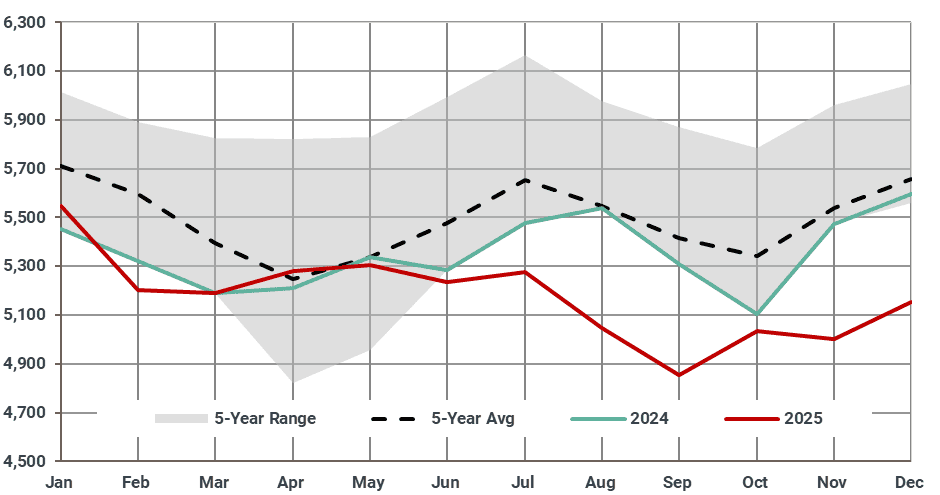
Source: Kpler
Refinery sites targeted by drone attacks, August–November 2025
RefineryCapacity, kbdDates listedNovokuibyshevsk1612 Aug, 28 Aug, 19 Oct, 16 NovVolgograd35613 Aug, 18 Sep, 15 Oct, 6 NovRyazan3762 Aug, 5 Sep, 23 Oct, 15 NovSaratov15016 Sep, 20 Sep, 16 Oct, 3 Nov, 28 NovSyzran17715 Aug, 24 Aug, 30 AugAfipsky15528 Aug, 26 Sep, 29 NovKirishi42013 Sep, 4 OctSalavat20918 Sep, 24 SepOrsk1163 Oct, 11 NovSlavyansk9013 Aug, 30 NovIlsky1317 SepKrasnodar6230 AugSamara-Kuibyshev14028 AugNovoil-Ufa14213 SepUfaneftekhim19015 OctNizhny Novgorod35916 Oct
Source: IIR & Kpler
2. A Smarter Targeting Strategy: From Crude Units to Critical Processing Units
Early in the campaign, CDUs (Crude Distillation Units) were the primary targets. But Ukraine (since Aug) has since been focusing on secondary and tertiary units that determine a refinery’s true output capability and produce most finished fuels—Hydrocrackers, FCCs, Hydrotreaters and Reformers. Comparatively, secondary unit’s outages (FCC, HCK, Coker, Reformer, Hydrotreater) are 550 kbd higher than last year. When these units are damaged, the refinery cannot make on-spec fuels, even if the CDU is still standing. These units also take longer to repair, rely on foreign and often sanctioned components, and represent the real bottlenecks in the system. In other words, Ukraine has started hitting not just the visible parts of the refinery, but the important clogs in the refining system that produce the final fuels.
Anecdotal evidence suggests that Russia is also facing shortages of high-spec refinery components—particularly reactor vessels, compressors, instrumentation, and speciality metallurgy—given sanctions-related restrictions on imports. Moreover, financing repair works and refinery expansions has become increasingly more expensive for Russian integrated companies over the past months, amid markedly elevated interest rates, as per Central Bank policies, further weighing on operations. Catalyst supply is less affected due to strong domestic output, but all these constraints are still delaying restarts and commissioning of the new bottom-upgrading unit.
Russia: lost refinery output due to drone strikes (kbd)
3. Product Tanks and Load ports are still part of the playbook
At the same time, Ukraine has not stopped striking fuel tanks at depots, refinery tank farms, and load ports. These big, exposed tanks are easy to ignite and cause huge fires that burn for hours or days. Recent strikes in places like Tuapse, Black Sea ports, Azov, Kursk, and Sochi/Sirius destroyed large volumes of diesel and gasoline that were ready to move into the domestic market or toward military logistics.
These hits matter because they remove immediate supply, not just future production. They tighten local availability, disrupt distribution flows, and create a constant sense of vulnerability in Russia’s energy infrastructure.
Bottom Line is that Ukraine is no longer trying to damage refineries: they are trying to disrupt them. The campaign has become multi-layered, sustained and strategically timed to maximise downtime and complicate repairs. The effects are structural rather than temporary, and they will continue to shape Russia’s near-term clean product availability, export patterns, and domestic supply security.
Want market insights you can actually trust?
Kpler delivers unbiased, expert-driven intelligence that helps you stay ahead of supply, demand, and market shifts. Our precise forecasting empowers smarter trading and risk management decisions.
Unbiased. Data-driven. Essential. Request access to Kpler today.

See why the most successful traders and shipping experts use Kpler
Kpler Insight: Get the analysis that matters